
The AI-first, action-native platform built for social commerce
TikTok Shop is not email. It is not a generic omnichannel inbox. It is a social-commerce conversation layer with structured post-sales requests, message cards, multi-shipment context, livestream chat, and an arbitration system that decides whether a return goes in the seller's favor or the buyer's. The right customer service platform for TikTok Shop is the one that turns that specific surface into automation, not the one with the longest feature list for email tickets.
This article compares three options sellers most often evaluate for TikTok Shop customer service: SmartReply, Zendesk, and Gorgias. We are scoping the comparison to TikTok Shop intentionally. We are not weighing email queues, voice channels, or generic omnichannel routing. Those are the strengths Zendesk and Gorgias built their reputations on. They are also not what TTS sellers actually need help with day-to-day.
Three things separate SmartReply from the other two for TikTok Shop:
SmartReply is AI-first.
Zendesk and Gorgias were both built around email-ticket workflows years before social commerce existed. SmartReply was designed from day one as an AI-first platform for social-commerce customer service.
SmartReply executes TikTok Shop actions natively.
Refunds, replacements, address updates, message cards, returns arbitration, and reviews: handled through a purpose-built AI Action System with an AI Approval governance layer. Gorgias's TikTok Shop integration was, in Gorgias's own words, "built by our partners," and the actions it does support link out to TikTok Shop's Seller Center for refunds and returns rather than executing them inside Gorgias. Zendesk's TikTok Shop integration is delivered by TikTok Shop itself and surfaces TTS's own widget inside Zendesk rather than building actions natively.
SmartReply is approved across every active TTS region.
Zendesk's TikTok Shop app is available only to sellers in the US and the UK. Gorgias's integration is US-only. SmartReply is live in the US, the UK, Brazil, Germany, Spain, France, Ireland, Italy, Japan, Indonesia, Malaysia, Singapore, Thailand, Vietnam, and more.
In this article
- The TikTok Shop test
- At a glance: feature comparison (6 tables)
- Built AI-first vs grafted onto legacy email
- The AI Action System: doing the work, not just answering tickets
- AI Approval: governance for AI autonomy
- Returns arbitration: the dashboard nobody else has
- TikTok Shop Reviews
- Global region readiness
- Setup friction
- Message cards, multi-shipment context, and automatic order updates
- The Search Sessions API and session-level analytics
- AI that understands TikTok-Shop-shaped work
- Pricing and total cost
- Where Zendesk and Gorgias do shine
- Who actually prioritizes TikTok Shop?
- Shop score on autopilot: who is actually watching it?
- The bottom line
The TikTok Shop test
A reasonable customer service platform answers tickets quickly. A great customer service platform for TikTok Shop finishes the work the conversation is about. On TTS, that work is overwhelmingly post-sales: a buyer wants a refund, a replacement on a partial-quality issue, a different shipping address before the package leaves the warehouse, a follow-up after a delivery exception. These are not free-text customer questions. They are structured requests that exist as first-class objects inside the TikTok Shop platform, with their own message-card UI, their own approval mechanics, and their own appeal pathway through TikTok Shop's arbitration system.
A general-purpose helpdesk built around an email ticket model can ingest these conversations, but it cannot finish them. To resolve a TTS post-sales request, the platform has to do one of the following:
- Approve or deny the request inside TTS.
- Trigger a refund or replacement workflow that TTS understands.
- Update the order's shipping address through the TTS API.
- Send a TTS message card back to the buyer.
- File or contest an arbitration appeal.
- Capture proof artifacts (photos, videos) and validate them against the request's schema.
The platforms that cannot do those things are forced to fall back to answering the ticket and telling the operator to log into Seller Center to actually resolve it. That keeps a human in the loop for almost every issue, regardless of how good the AI's reply text sounds. The platforms that can do those things eliminate the human step for the majority of common requests.
That is the test. The rest of this article is about how each platform performs on it.
At a glance: feature comparison
The tables below are the visual centerpiece of the comparison. Skim them, then read the sections that matter to you.
Group 1 of 6
TikTok Shop fit
| Capability | SmartReply | Zendesk | Gorgias | Zendesk | ||||||||||||||||||||||||||||||||||||||||||||||||||||||||||||||||||||||||||||||||||||||||||||||
|---|---|---|---|---|---|---|---|---|---|---|---|---|---|---|---|---|---|---|---|---|---|---|---|---|---|---|---|---|---|---|---|---|---|---|---|---|---|---|---|---|---|---|---|---|---|---|---|---|---|---|---|---|---|---|---|---|---|---|---|---|---|---|---|---|---|---|---|---|---|---|---|---|---|---|---|---|---|---|---|---|---|---|---|---|---|---|---|---|---|---|---|---|---|---|---|---|---|---|
| Built for social commerce | AI-first social-commerce platform | Built around email and omnichannel ticketing | Built around Shopify helpdesk | Built around email and omnichannel ticketing | ||||||||||||||||||||||||||||||||||||||||||||||||||||||||||||||||||||||||||||||||||||||||||||||
| Native TTS post-sales actions | Full AI Action System | Surfaces TTS's own widget; no native action APIs | Widget links out to Seller Center for refunds and returns; cannot execute TTS actions in Gorgias | Surfaces TTS's own widget; no native action APIs | ||||||||||||||||||||||||||||||||||||||||||||||||||||||||||||||||||||||||||||||||||||||||||||||
"This integration was built by our partners." Source: Gorgias documentation, April 2026 | ||||||||||||||||||||||||||||||||||||||||||||||||||||||||||||||||||||||||||||||||||||||||||||||||||
| TTS shopper purchase history in conversation | Live-synced | Limited (TTS widget) | Yes, supported | Limited (TTS widget) | ||||||||||||||||||||||||||||||||||||||||||||||||||||||||||||||||||||||||||||||||||||||||||||||
| Automatic TTS message cards from AI | Plain-text import in our testing | Manual via widget; not AI-automated | Plain-text import in our testing | |||||||||||||||||||||||||||||||||||||||||||||||||||||||||||||||||||||||||||||||||||||||||||||||
| Handles TikTok DMs and comments (in addition to Shop messages) | Limited | Limited | ||||||||||||||||||||||||||||||||||||||||||||||||||||||||||||||||||||||||||||||||||||||||||||||||
| Language support | Multi-language | Multi-language | English-only (Gorgias docs) | Multi-language | ||||||||||||||||||||||||||||||||||||||||||||||||||||||||||||||||||||||||||||||||||||||||||||||
| TTS Reviews integration | Early access (verified April 2026) | |||||||||||||||||||||||||||||||||||||||||||||||||||||||||||||||||||||||||||||||||||||||||||||||||
| TTS Returns Arbitration Dashboard | ||||||||||||||||||||||||||||||||||||||||||||||||||||||||||||||||||||||||||||||||||||||||||||||||||
Group 2 of 6
Region coverage
| Capability | SmartReply | Zendesk | Gorgias | Zendesk |
|---|---|---|---|---|
| United States | ||||
| United Kingdom | ||||
| Brazil | ||||
| Germany | ||||
| Spain | ||||
| France | ||||
| Ireland | ||||
| Italy | ||||
| Japan | ||||
| Indonesia | ||||
| Malaysia | ||||
| Singapore | ||||
| Thailand | ||||
| Vietnam | ||||
| And more active TTS regions | Limited to US and UK | US only | Limited to US and UK |
Group 3 of 6
AI automation depth
| Capability | SmartReply | Zendesk | Gorgias | Zendesk |
|---|---|---|---|---|
| AI Action System tied to TTS request types | Tied to Shopify Actions | |||
| AI Approval workflow | ||||
| Live-synced with TTS app and operator requests | ||||
| Escalate Action (auto-reply off + ticket) | Manual | Manual | Manual | |
| Message Trainer | ||||
| AI reads videos in post-sales requests | ||||
| Dynamic Video Instruction | ||||
| Proactive outreach for post-sale issues | ||||
| Proof-validation loop | ||||
| Knowledge-base ingestion for AI |
Group 4 of 6
Setup and integration
| Capability | SmartReply | Zendesk | Gorgias | Zendesk |
|---|---|---|---|---|
| Built and supported by the platform | Integration delivered by TikTok Shop | Built by partners (per Gorgias docs) | Integration delivered by TikTok Shop | |
| Setup and AI optimization timeline | Setup in 1 hour, optimized in 2 weeks | 2 months to optimize, and never reaches SmartReply depth | About 2 months for AI Agent, and still limited by Shopify-only actions | 2 months to optimize, and never reaches SmartReply depth |
| Sidebar UI | Native SmartReply | TTS's own widget inside Zendesk | Gorgias UI, no TTS actions | TTS's own widget inside Zendesk |
| One-click TTS connection |
Group 5 of 6
Analytics and reporting
| Capability | SmartReply | Zendesk | Gorgias | Zendesk |
|---|---|---|---|---|
| TTS Search Sessions API ingestion | ||||
| Session-level shopper analytics | Ticket-level | Ticket-level | Ticket-level | |
| Daily granular TTS metrics | ||||
| CSAT tied to TTS sessions | ||||
| Arbitration win-rate measurement |
Group 6 of 6
Pricing posture
| Capability | SmartReply | Zendesk | Gorgias | Zendesk |
|---|---|---|---|---|
| Pricing model | Credit-based: one credit per message or action processed | Per-seat plus per-resolution AI on top | Per-ticket plus AI Agent resolution bundles | Per-seat plus per-resolution AI on top |
| TTS-equivalent cost vs peers | Lower | Higher (especially with AI add-ons) | Higher at AI volume | Higher (especially with AI add-ons) |
Built AI-first vs grafted onto legacy email
Zendesk has been around since 2007. Gorgias launched as a Shopify-first helpdesk later. Both grew up serving a particular shape of work: the email ticket. Multi-channel support, social inboxes, AI agents, and ecommerce integrations were all stacked on top of that core, in that order. That heritage is not a slight. Zendesk in particular is one of the most mature CX platforms in the market. But the heritage is real, and it shapes the data model, the automation primitives, and the UX.
SmartReply was built differently. It was designed from the start as an AI-first platform for social-commerce customer service, with TikTok Shop as a primary use case rather than an add-on connector. The implications run through the whole product:
- The data model centers on customer sessions and post-sales requests, not tickets. A buyer who messages, files a return, watches a livestream, and comes back two days later is one continuous session, not three disconnected tickets.
- Automation primitives center on actions the AI can execute, not macros the agent has to run.
- The default UX assumes the AI is doing the work and the operator is reviewing it, not that the operator is doing the work and the AI is suggesting replies.
That foundation is why SmartReply can answer "what does the AI actually do on TikTok Shop?" with a list of verbs, not a list of message templates.
The AI Action System: doing the work, not just answering tickets
If you log a week of TikTok Shop tickets and tag them by request type, you will find that the long tail is small. The vast majority of inbound volume falls into a handful of patterns: refund request, replacement request, address change, delivery exception, "where is my order," "this arrived broken," and a thin layer of pre-sale questions on top. SmartReply's AI Action System is built to execute those exact verbs.
What SmartReply's AI can do on TikTok Shop
SmartReply AI actions: resolving requests end to end without human intervention
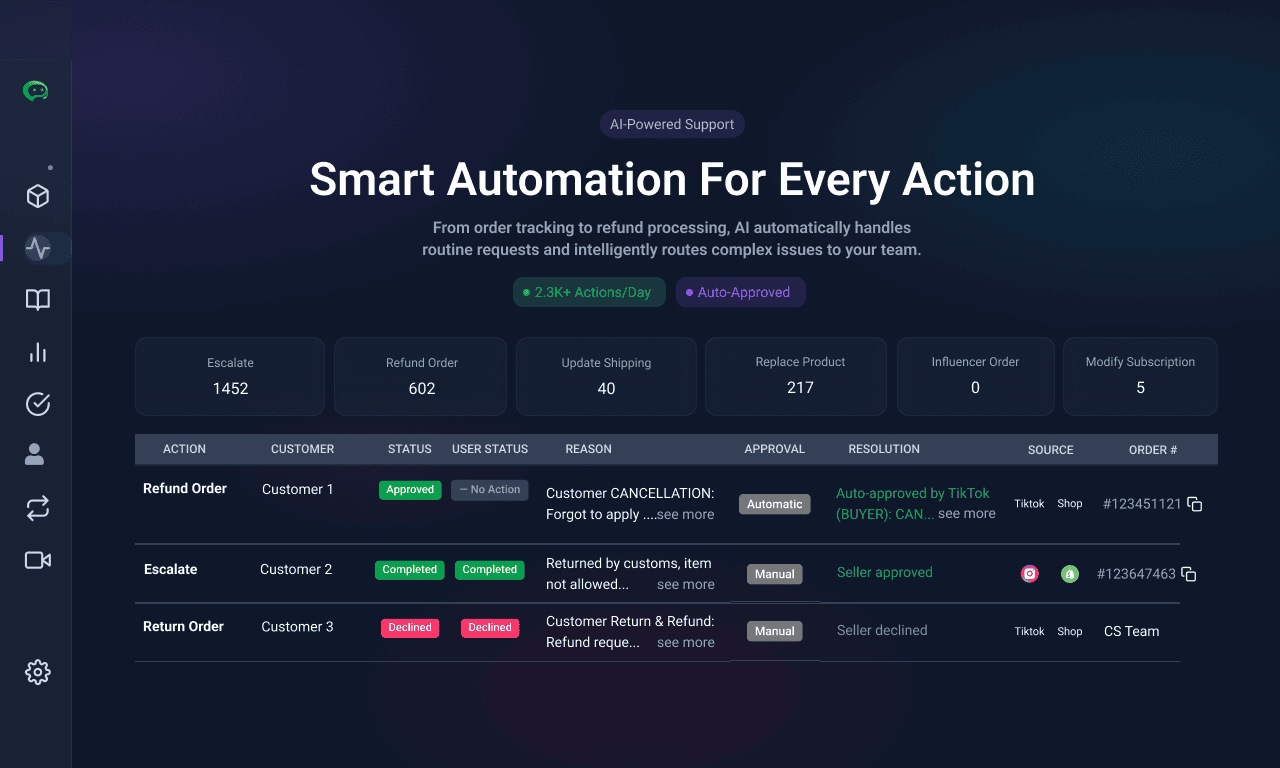
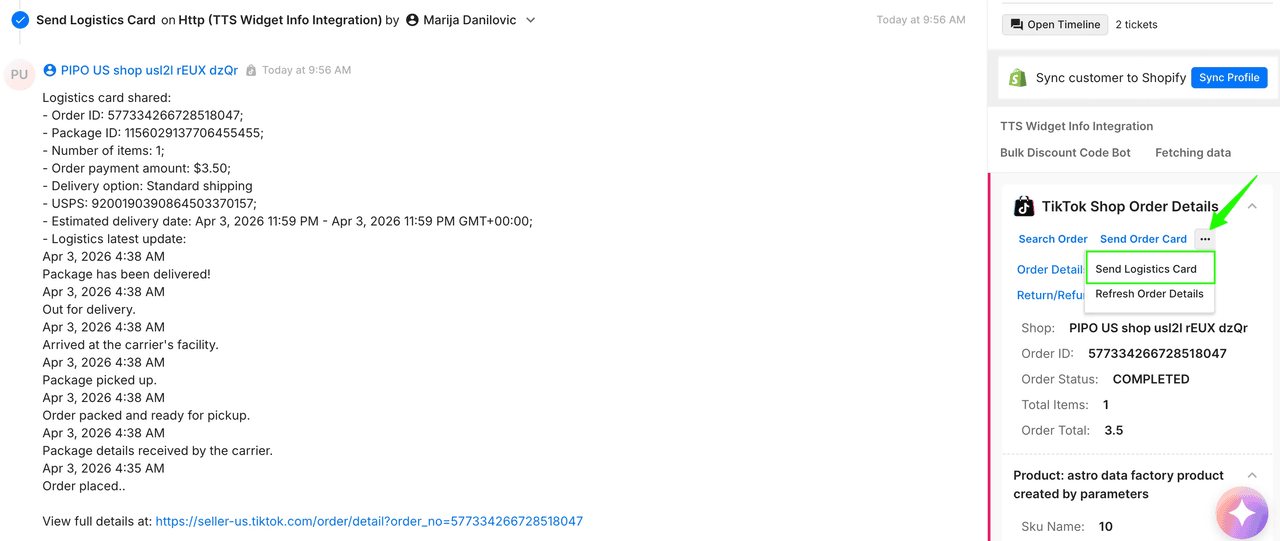
What Gorgias's AI can do on TikTok Shop: Gorgias's TikTok Shop integration is, in Gorgias's own words, "built by our partners," not by Gorgias themselves. The widget's full action set is six items, and reading the list tells you most of what you need to know:
- Order details: opens the order in TikTok Shop's Seller Center
- Return/Refund Information: opens the Manage returns page in Seller Center
- Send Order Card: sends a pre-built order card via the widget
- Search Order: searches for an order in the widget
- Send Logistics Card: sends a pre-built logistics card via the widget
- Refresh Order Details: refreshes the order in the widget
None of those executes a refund. None approves a replacement. None updates a shipping address. None files an arbitration appeal. None proactively reaches out to a customer. For the substantive post-sales work, the agent clicks "Order details" or "Return/Refund Information" and then completes the action inside TikTok Shop's Seller Center. The widget is a viewer with two card-send shortcuts, not an action surface.
The integration is also US-only, English-only, and, per Gorgias's documentation, "specifically addresses TikTok Shop interactions, excluding the handling of direct messages (DMs) and comments." That last point is significant. SmartReply handles TikTok DMs and comments; Gorgias's TTS integration explicitly does not.
Gorgias's AI Agent is genuinely strong on Shopify. It can issue refunds, edit orders, and cancel orders through Shopify Actions. None of that translates to TikTok Shop. The Shopify Actions surface is a different platform with a different API. On TTS, Gorgias is a thin conversational layer with a small set of view-and-link-out shortcuts.
What Zendesk's AI can do on TikTok Shop: The Zendesk for TikTok Shop app is listed in the Zendesk Marketplace, but it is provided by TikTok Shop, not by Zendesk. It is free for current Zendesk Support subscribers. Functionally, it pipes TTS messages into Zendesk and gives agents access to TTS's own sidebar widget so they can act on requests inside that widget, rather than acting on them through Zendesk's APIs. In our testing, message imports through the integration come through as plain text, and the TTS message-card UI does not render in the conversation as it does inside TTS itself. Zendesk's broader AI features are powerful for general ticketing, but they do not have hooks into TTS-specific actions. They classify intent and suggest replies. They do not approve a TTS replacement request.
The practical effect
On TikTok Shop, SmartReply finishes the request. The other two platforms route the message to a human who finishes it.AI Approval: governance for AI autonomy
Letting AI execute sensitive actions such as refunds, replacements, and returns approvals is a governance question, not just an automation question. SmartReply's answer is the AI Approval system: AI proposes the action, the operator sees the proposed action in a queue, and the team approves or rejects with a single click. The AI's proposal is fully formed and ready to ship; the operator's role is judgment, not data entry.
Two design choices make this work:
- Live-synced with TikTok Shop. Requests submitted inside the TTS app or through a TTS operator flow into the same approval queue, so the team can handle TTS-native requests through the same workflow as conversation-driven ones. Operators are never bouncing between Seller Center and the helpdesk.
- Operator instructions become AI policy. Standing instructions (decline replacements without photo proof, auto-approve refunds under $20 for repeat buyers, always escalate Vietnam shipping exceptions to a human) shape the AI's proposals. The AI is not freelancing; it is executing policy at scale.
Neither Zendesk nor Gorgias has an equivalent surface for TikTok Shop, because neither platform is executing TTS actions in the first place. The best approximation either offers is "your agent reads the suggested reply and clicks send," which is materially different from "your team approves a fully-formed TTS post-sales action." The former saves typing time. The latter saves the action itself.
Returns arbitration: the dashboard nobody else has
TikTok Shop's appeal mechanism is one of the highest-leverage surfaces a TTS seller has, and it is also one of the most operationally annoying. Every appeal is its own small case: was the item misrepresented, was the buyer at fault, was there evidence at the right time, did the response window close. Sellers who do this well measure their win rate by reason code and improve the inputs over time.
SmartReply has a dedicated TTS Returns Arbitration Dashboard for exactly this. It groups post-sales actions by reason, exposes win rate per reason, and surfaces the variables you can actually move: evidence quality, response timing, buyer history. AI Approval is the lever; the dashboard is how you measure whether you're pulling it correctly.
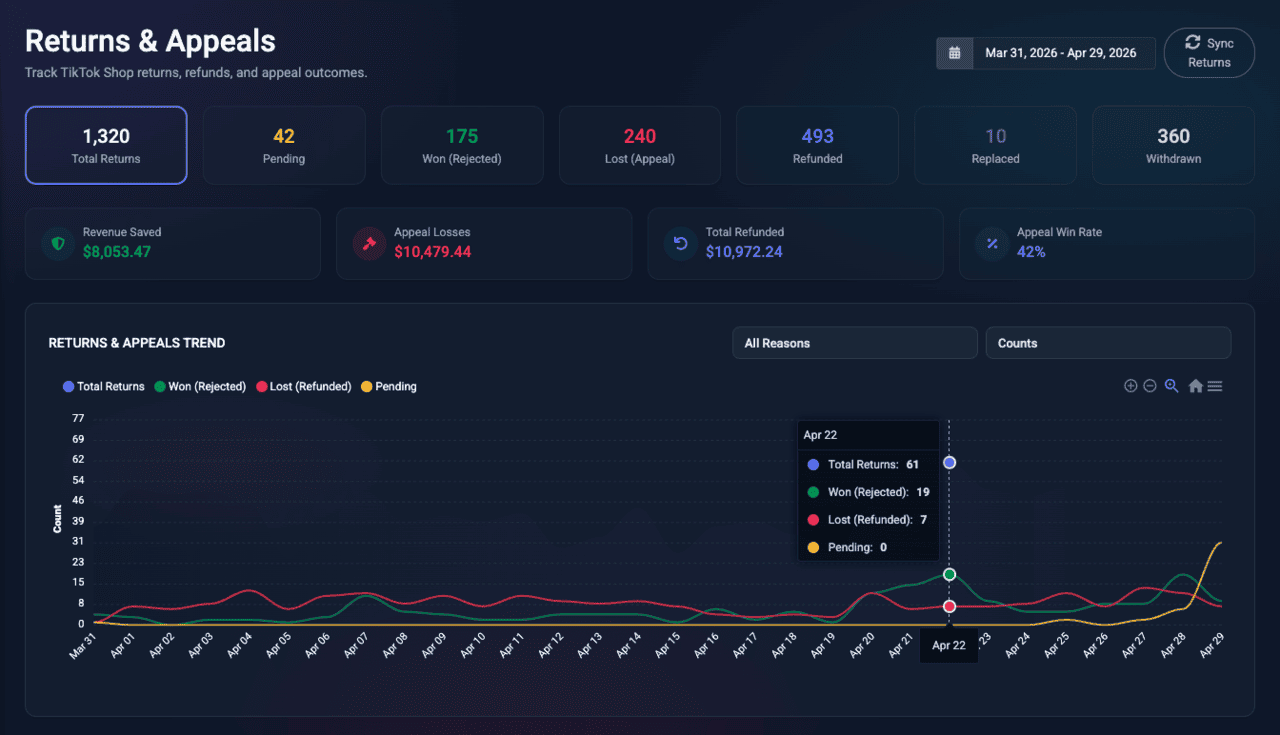
SmartReply's Returns and Appeals dashboard: total returns, appeal win rate, and trend data in one surface.
We have seen meaningful arbitration win-rate improvements when sellers move their post-sales workflow from manual to AI-assisted in SmartReply. The point is structural, not statistical: arbitration is measurable, optimizable work, and SmartReply is the only one of these three platforms that exposes it as a measurable, optimizable surface.
Zendesk and Gorgias do not have a dashboard for this. They cannot, because they do not execute the underlying actions; the data is not in their systems to begin with.
TikTok Shop Reviews: Only on SmartReply
TikTok Shop Reviews is an emerging surface for TTS sellers. As of April 29, 2026, SmartReply is the only one of these three platforms with an integration for TTS Reviews, via TikTok Shop's early-access program. Neither Zendesk nor Gorgias has shipped a TTS Reviews integration.
Why does that matter operationally? Because review management on TTS is part of post-sale customer experience, and post-sale customer experience is precisely the surface that affects whether a buyer ever comes back. Sellers who treat reviews as a separate inbox in a separate tool pay the tax of context switching, slower response, and uncoordinated tone. SmartReply pulls review responses into the same AI Action surface as everything else.
Global region readiness
For sellers operating across markets, this is one of the most concrete differentiators on the list.
Zendesk for TikTok Shop is available to TTS sellers in the United States and the United Kingdom only. That is per TikTok Shop's own seller documentation. If you operate in any other TTS region, including Brazil, Germany, France, Japan, Indonesia, Malaysia, Singapore, Thailand, or Vietnam, the official Zendesk for TikTok Shop app cannot be used. Some sellers work around this with third-party bridges like ChannelReply, which is a separate product and a separate vendor.
Gorgias's TikTok Shop integration is available only to US-based TikTok shops. There is no UK option. There is no Southeast Asia option. There is one region.
SmartReply is approved across every active TTS region we have tested: the United States, the United Kingdom, Brazil, Germany, Spain, France, Ireland, Italy, Japan, Indonesia, Malaysia, Singapore, Thailand, Vietnam, and more. For a partner planning to scale customer service across multiple markets or to standardize on one platform globally so the team's playbook moves with them, there is one option in this comparison that doesn't fragment by geography.
Setup friction: how long until you're answering tickets
Two things tend to dominate the early experience with a customer service platform: how long it takes to connect TTS, and how long it takes for the AI to be useful.
Zendesk for TikTok Shop requires the seller to install the app, authorize it on both the Zendesk and TikTok Shop sides, and then invest meaningful admin time customizing routing rules, triggers, macros, and SLAs. For sellers approaching from scratch, Zendesk's admin density is real and well-documented in third-party reviews. Expect roughly two months before the AI is operating at a level you trust, and even then the ceiling is not comparable to a purpose-built social-commerce platform.
Gorgias's AI Agent installs quickly for Shopify-native sellers. The friction comes after: AI Agent requires meaningful tuning before it answers customers in a way that brand teams are comfortable with. That process commonly takes around two months, and even then the AI's autonomous capabilities outside Shopify-native actions are limited to text replies. The ceiling is structurally lower than what a TikTok-Shop-native AI can do, so the optimization effort never fully closes the gap.
SmartReply is built for a different timeline. Connect your TikTok Shop in a single OAuth, ingest your knowledge base, run the Message Trainer against existing conversation transcripts, and the AI is producing on-brand TTS replies and proposing actions through AI Approval within an hour. Most sellers reach a fully optimized state within two weeks.
Message cards, multi-shipment context, and automatic order updates
If you have used TTS as a buyer, you know the message cards: the structured order card, the shipping card, the product card. They are the language of the platform, and on the agent side, sending the right card at the right moment is what a competent reply looks like.
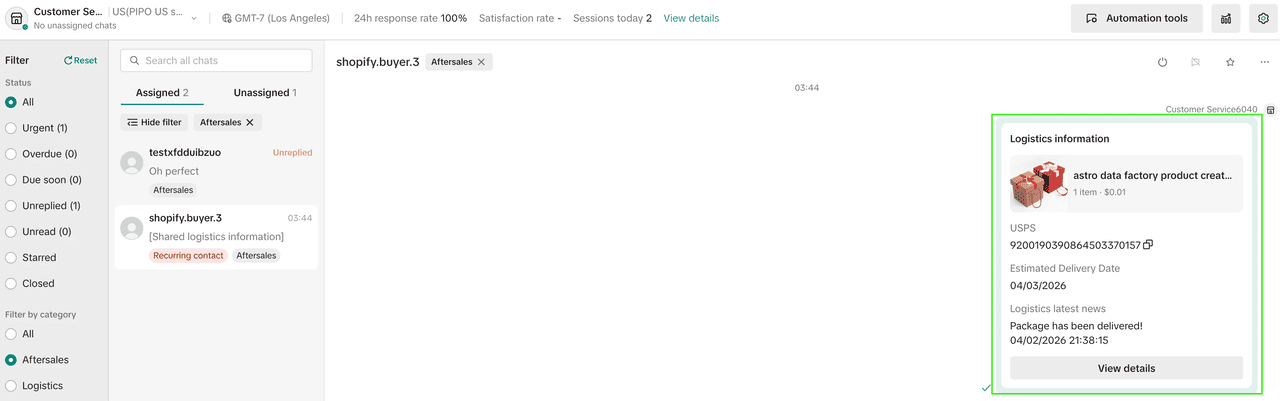
SmartReply sends TTS message cards automatically, in line with the conversation. The AI knows when to send a shipping card, when to send an order summary, and when to send a product reference. It also handles multi-shipment context correctly. When an order is split across multiple shipments, the AI tracks each one and sends per-shipment updates rather than one ambiguous "your package is on its way" reply. Setting this up is a click, not a script.
SmartReply: automatic order updates sent in conversation
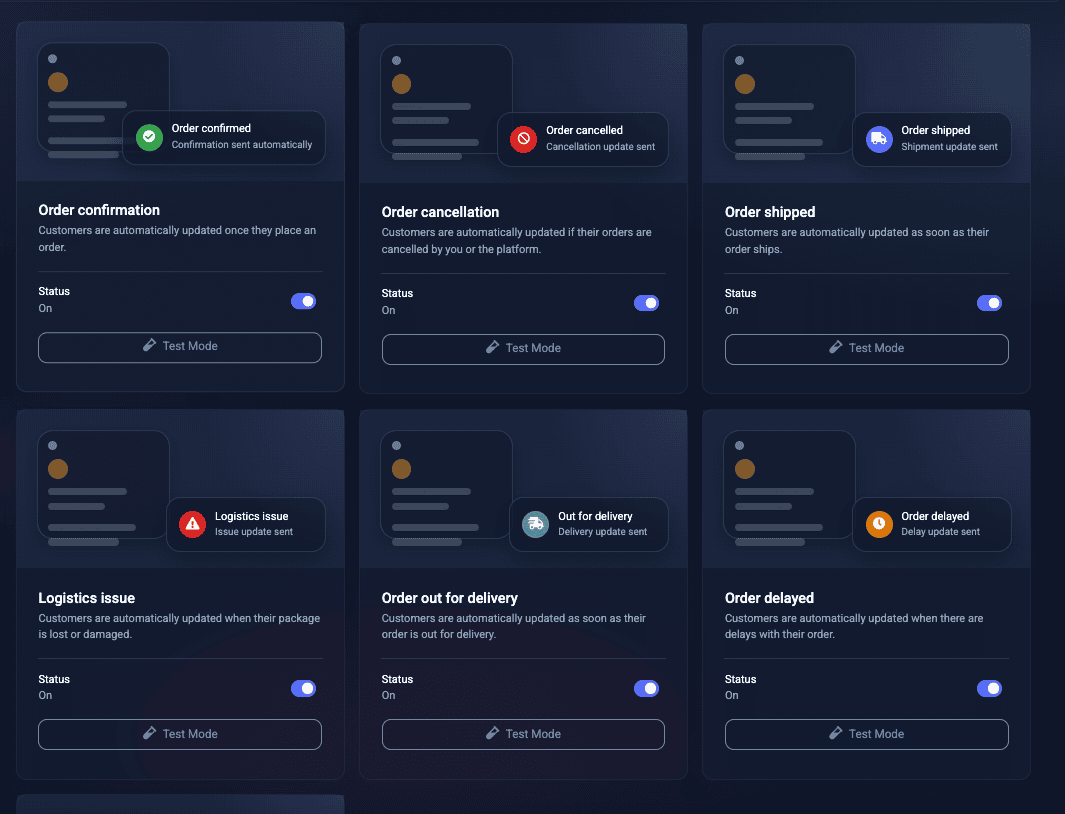
SmartReply TikTok Shop message cards, sent automatically by the AI
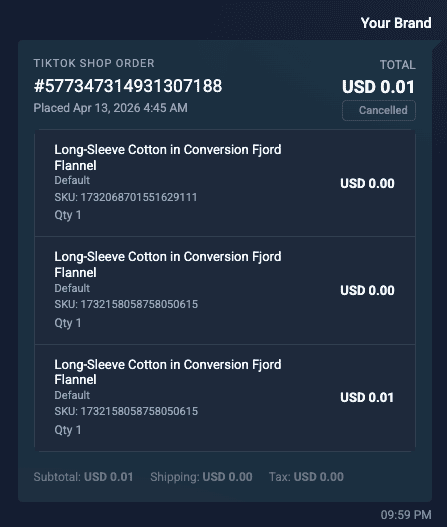
Order Card
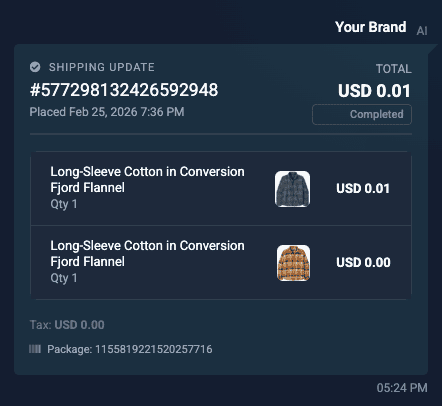
Logistics Card
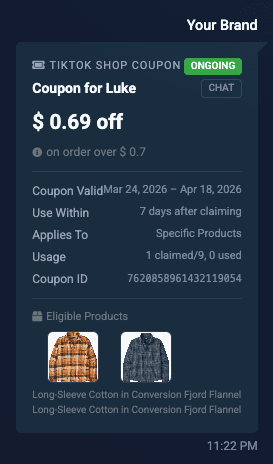
Coupon Card

Product Card
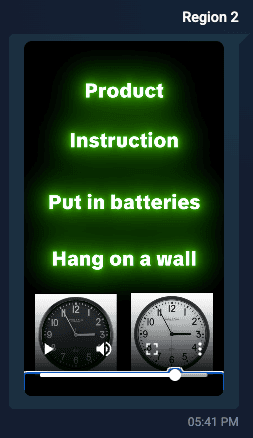
Video Card
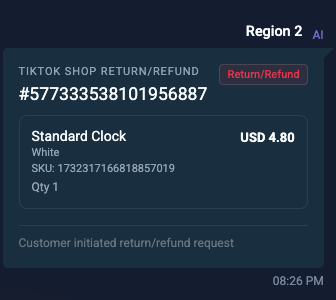
Refund Card
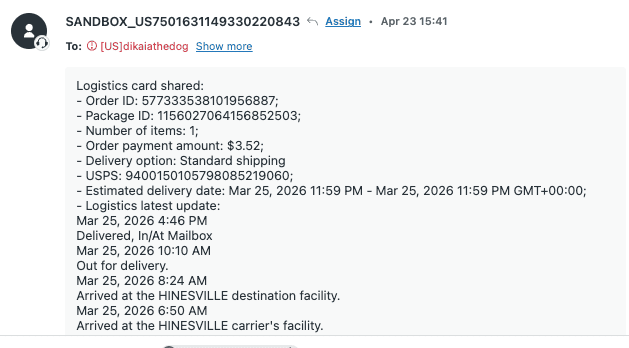
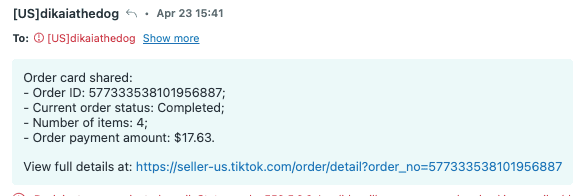
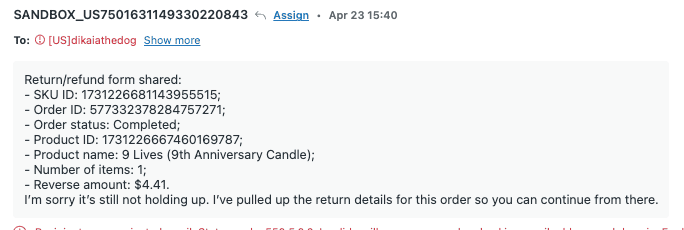
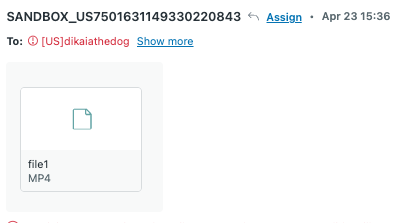
Zendesk's TTS integration, in our hands-on testing, imports messages as plain text. The TTS message-card UI does not render natively in Zendesk the way it does inside TTS itself. Agents who want to send a message card use the embedded TTS widget inside the Zendesk sidebar, which works, but means the action is happening through TTS's UI rather than Zendesk's, and the agent loses the speed benefit of acting through their primary tool. Zendesk's own AI does not autonomously send TTS message cards.
Zendesk: TikTok Shop message cards rendered as plain text in the agent view
Screenshots from hands-on testing
Gorgias's TTS integration supports Send Order Card and Send Logistics Card from the agent-side widget, but they are manual actions. An agent has to click each card to send it. There is no AI-driven, in-conversation card delivery, no multi-shipment-aware automation, and no AI logic for choosing which card the conversation actually needs.
Gorgias: TikTok Shop messages arrive as plain text, not formatted cards
Screenshots from Gorgias documentation

The Search Sessions API and session-level analytics
The TikTok Shop Search Sessions API is one of the newer surfaces in the TTS data layer. It exposes session-level shopper journey data: what a user searched, what they viewed, where they bounced, where they bought. That granularity lets a seller measure customer experience as a funnel rather than as a queue of tickets.
SmartReply ingests Search Sessions data and combines it with conversation, action, and arbitration data to produce session-level analytics, daily granular TTS metrics, and CSAT scores tied to TTS sessions rather than email tickets. The result is that you can ask questions a ticket system cannot answer: which product categories are losing buyers at the post-purchase stage, which arbitration reasons are dragging satisfaction down, which proactive outreach pattern lifts repurchase rates. That is the analytics surface a CX team running on TikTok Shop actually needs.
Neither Zendesk nor Gorgias surfaces TTS Search Sessions data today. Their analytics live at the ticket and agent level: response times, first-contact resolution, agent throughput. Those are valuable in their own right but do not connect to the funnel where TTS revenue is actually decided.
AI that understands TikTok-Shop-shaped work
A handful of smaller capabilities round out the picture. None is, by itself, the reason to choose SmartReply. Together, they are the reason SmartReply's AI feels like it understands TTS.
Message Trainer
Train the AI against specific conversation flows so replies don't sound like AI. This is the feature most cited by SmartReply customers as the moment their AI started feeling like a member of the team. Neither Zendesk nor Gorgias has an equivalent.
AI watches videos
Buyers attach video to TTS post-sales requests all the time: here is what arrived, here is what I ordered. SmartReply's AI ingests and reasons about that video as part of the request. Zendesk and Gorgias treat video as an attachment.
Dynamic Video Instruction
A SmartReply feature that supports dynamic video-based instructional responses for buyers who need walkthroughs: returns flow, setup, product use.
Proactive outreach
SmartReply automatically reaches out to buyers when something has gone wrong post-purchase: a delivery exception, a missing piece of a virtual bundle, a stalled shipment. It fixes the issue before the buyer escalates. The other two platforms reach out when an operator clicks a button.
Proof-validation loop
When a buyer files a TTS post-sales request without the proof the policy requires (photos for damage claims, for instance), SmartReply's AI declines politely, requests the missing artifacts, and walks the buyer through correcting the submission. The end state is a complete, valid request, which has a better arbitration outcome than the original.
The pattern: AI that has been built to reason about TikTok Shop's actual content and policy structure, not just AI that has been pointed at TikTok Shop's text channel.
Pricing and total cost
A full pricing comparison depends on contract terms and volume, and the headline numbers each vendor publishes are not directly comparable. The structural points are these:
Zendesk
Prices per agent seat, with advanced AI features charged per resolution on top. Suite Professional and Suite Enterprise are the two main tiers. Heavy AI use stacks on top of seats, so cost scales with both team size and automation volume.
Gorgias
Prices per ticket and bundles AI Agent resolutions in volume packs. Their AI Agent resolution pricing is roughly a dollar per resolution, paid in bundles. As AI volume scales, the AI bundle cost stacks on top of the seat-style base.
SmartReply
On a TTS-equivalent workload, less expensive than either, and the automation depth means more of the work is being done per dollar than on platforms where AI handles only conversation and a human handles every action.
The real question for a TTS-focused buyer is not "what is the seat price." It is "what is my fully-loaded cost per resolved post-sales request." On that metric, SmartReply tends to be the lowest of the three for a TTS workload, because the platform is closing more tickets without an operator action.
Where Zendesk and Gorgias do shine
Honesty matters in a comparison article, so we will say this plainly: Zendesk and Gorgias are good products. They are not the right products for TikTok Shop, but they are the right products for adjacent jobs.
Zendesk
One of the best omnichannel ticketing platforms in the market. Enterprise-grade routing, workforce management, robust admin controls, mature reporting at the higher tiers, broad integration ecosystem, and a strong AI roadmap on the general-CX side.
Best when: When your primary support volume is email and voice, and TTS is a small share of total contacts.
Gorgias
The gold standard for Shopify-native ecommerce support. Tight Shopify Actions, ecommerce-aware AI Agent, revenue-tied analytics, and a customer base full of fast-growing DTC brands.
Best when: When your storefront is Shopify and TTS is a side channel.
Neither of those strengths is what TikTok Shop sellers are buying for, especially TTS-first or TTS-primary sellers. That is the job SmartReply was built for, and it is the only one of the three platforms that was.
Who actually prioritizes TikTok Shop?
There is a question behind all the feature comparisons that rarely gets asked directly: which of these companies actually cares about TikTok Shop as a primary business? The answer shapes everything, from how fast the integration moves to whether the team on the other end of your support ticket has ever filed a TTS arbitration appeal themselves.
Zendesk
LowZendesk's TikTok Shop app was built and is maintained by TikTok Shop, not Zendesk. Zendesk's own roadmap is oriented around enterprise omnichannel ticketing. TikTok Shop is one connector among dozens in their marketplace.
Gorgias
LowGorgias was built on Shopify. Their core business, their AI Agent, and their roadmap are Shopify-native. The TTS integration is a US-only, action-free connector that their own documentation describes with a list of things it cannot do.
SmartReply
Core productTikTok Shop is not a channel SmartReply added. It is what SmartReply was built for. Every product decision, every AI Action, every dashboard, and every regional expansion is driven by what TTS sellers actually need.
This matters operationally. When TikTok Shop ships a new API surface, SmartReply is the platform most likely to have it in production first, because TTS is the reason the company exists. The TTS Reviews early-access integration is one example. The arbitration dashboard is another. Those were not backlog items waiting for a sprint to free up. They were shipped because TTS sellers needed them.
Shop score on autopilot: who is actually watching it?
TikTok Shop's seller score is one of the most consequential numbers in a seller's business. It affects visibility, the ability to run promotions, standing in the affiliate marketplace, and ultimately whether buyers see your products at all. Every delayed response, every unresolved post-sales request, every arbitration loss, and every negative review moves it. Managing the shop score is not a weekly reporting exercise. It is a live operational discipline.
SmartReply is built around protecting and improving the shop score. The AI responds to every message within 30 to 90 seconds around the clock. The AI Approval workflow closes post-sales requests before they age into score penalties. The Arbitration Dashboard measures win rate by reason code so sellers can fix the inputs, not just observe the outputs. The CSAT system is tied to TTS sessions, not generic satisfaction scores that float free of any specific surface.
Zendesk and Gorgias do not have a shop score concept anywhere in their product. There is no dashboard, no alert, no AI behavior tuned around it. That is not a criticism. It is a scope statement. Their products were not designed to manage TTS seller scores, and they show that faithfully.
| Shop score lever | SmartReply | Zendesk | Gorgias |
|---|---|---|---|
| 30 to 90 second AI response time, 24 hours a day | |||
| Post-sales requests closed before score penalties accrue | |||
| Arbitration win rate tracked and optimizable | |||
| CSAT tied to TTS sessions | |||
| Proactive outreach to fix issues before the buyer escalates | |||
| TTS Reviews managed in the same AI surface |
The practical effect: a seller running SmartReply has their shop score managed automatically. Response times are handled by AI. Post-sales requests are closed by AI. Arbitration is tracked and optimized. The seller reviews the work through AI Approval rather than doing it manually. The shop score improves as a byproduct of the system doing its job, not as the result of a dedicated manual effort. With Zendesk or Gorgias, a seller could replicate some of this manually, but the platform is not helping them and was never built for this job.
The bottom line
If you are building a customer service operation for TikTok Shop, the comparison comes down to three structural facts:
SmartReply is AI-first; Zendesk and Gorgias are email-legacy.
The data model, the automation primitives, and the UX of SmartReply were designed for the way TTS actually works. The other two were designed for tickets and adapted.
SmartReply executes TTS actions natively; the other two do not.
Refunds, replacements, address changes, message cards, returns arbitration, and reviews are first-class verbs in SmartReply's AI Action System. Gorgias's own documentation describes a partner-built widget that links out to Seller Center for refunds and returns rather than executing them inside Gorgias. Zendesk's TTS integration is a TikTok-Shop-built bridge that surfaces TTS's own widget rather than building actions natively.
SmartReply is approved across every active TTS region.
Zendesk's TTS app is US and UK only. Gorgias's TTS integration is US-only. SmartReply is global.
Add it all up
The AI Approval governance layer, the Returns Arbitration Dashboard, the Search Sessions analytics, the TTS Reviews early access, the Message Trainer, and the Dynamic Video Instruction feature together make the picture clear. SmartReply is the only one of these three platforms purpose-built for TikTok Shop customer service, and the only one a partner planning a global TTS launch should standardize on.If you are evaluating a customer service platform for TikTok Shop, talk to us. We will run a side-by-side against whatever you are using today, in your data, on your conversations.